Israeli forces continue to be active south of the Yellow Line established last week in Lebanon, destroying villages and building up a command structure to support an open ended military occupation of that territory.
The IDF is said to envision not only occupying the southern-most “buffer zone” inside Lebanon, but also to create what Israeli planners call a “hunting and pursuit zone” between the Yellow Line and the Litani and Awali River, whereby they would continue operating with impunity.
Further complicating matters, Israel’s Yellow Line is not a straight line by any means, and gets decidedly angled when one reaches the Mediterranean Sea. There’s a method to this line, which cuts deep into Lebanon’s territorial waters.
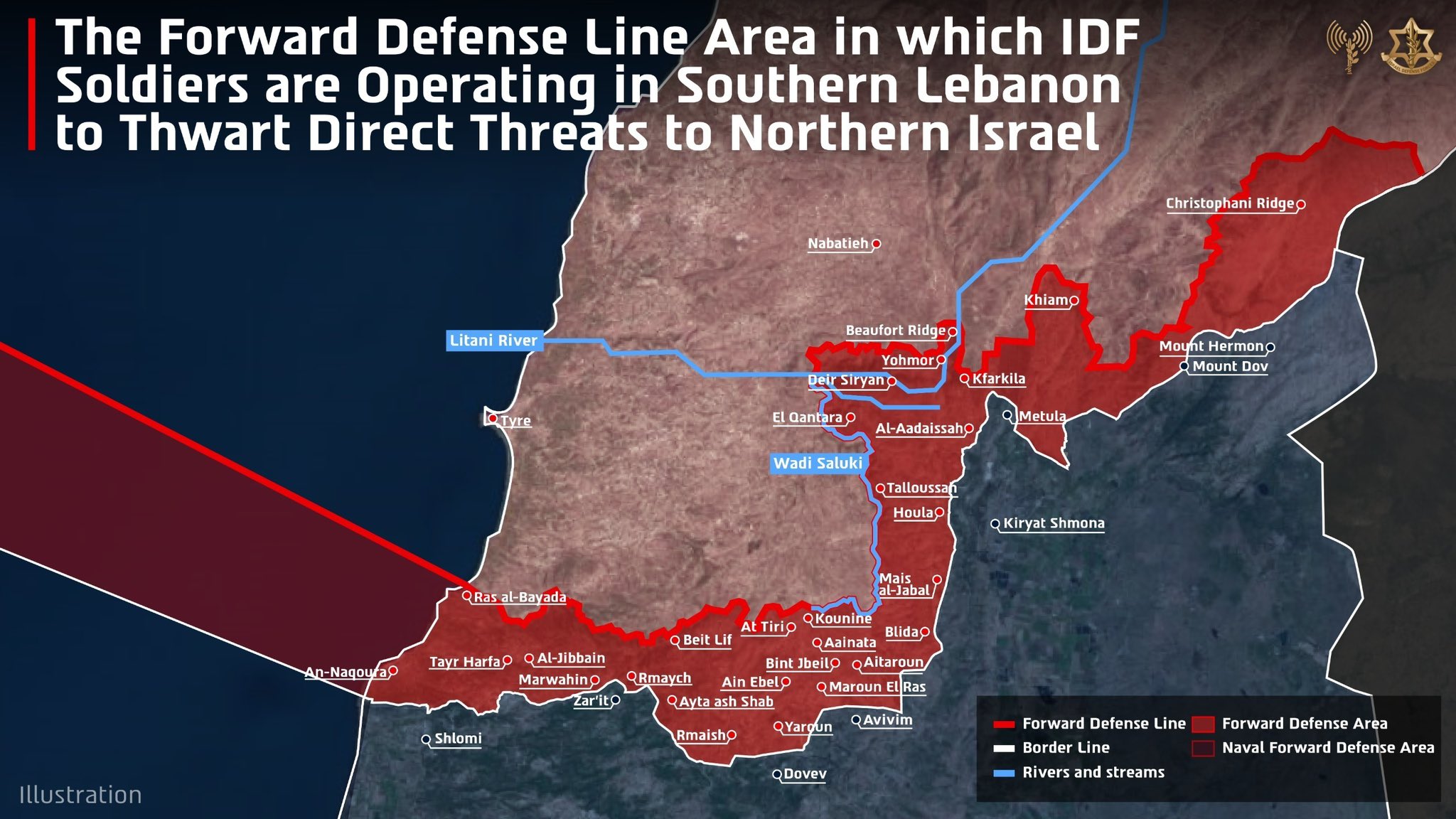
This puts the economically important Qana gas field wholly within the “buffer zone,” putting the site, estimated to be worth $20-$40 billion dollars, wholly out of Lebanon’s reach and under the operational control of the Israelis.
Israel and Lebanon has a maritime dispute over multiple offshore gas fields that spanned each of their claimed maritime borders. In 2022, the two nations reached an agreement whereby Israel would have full control of the Karish field, whereas Lebanon would have control of the further north Qana field, though with the caveat that Israel was entitled to royalties on parts of the field because previously some Israeli maps angled the border line enough that those parts could be claimed by Israel.
The Yellow Line now effectively makes the Qana field off-limits to Lebanon, and part of the Israeli-occupied buffer zone. While not as immediately impactful of the dozens of villages the IDF intends to levels in the zone are, the loss of Qana could do substantial economic harm to Lebanon in the long-term.