Wednesday saw Israel continuing to attack towns and villages across southern Lebanon, wounding several people in strikes on Mansouri, Beit Yahoun, and Zawtar al-Sharqiyeh. Such strikes are effectively a daily occurrence in those areas.
That’s particularly true of Mansouri, which is adjacent to one of the “pilot zones,” and where the growing escalation of Israeli artillery shelling and drone strikes in raising concerns about the war ratcheting up again, after weeks of relatively low death tolls.
The most immediate concern in southern Lebanon, however, isn’t what has happened in the war, or is likely to happen in the near future, but rather what is currently happening, which is a soaring number of forest fires caused by rural Israeli strikes.
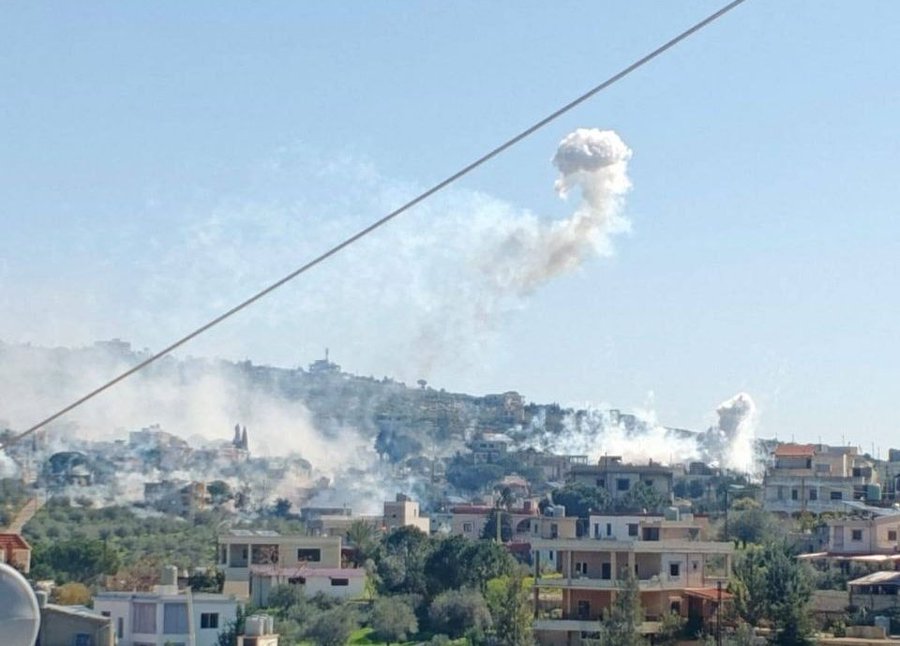
White phosphorous munitions deployed over Khiam | Image from X
Israeli forces have been dropping incendiaries on the forests in areas like Khiam and civil defense officials are saying that increasingly, those forest fires are taking up most of their attention, and seemingly this is deliberate, as Israel is dropping flares into forests and predictably setting them ablaze.
Defense Minister Israel Katz has been bragging about how many villages he’s completely destroyed over the course of the Israeli war, which began in early March. While destruction in the villages continues apace, there’s been growing attention to how many forests, orchards, and general farmland that Israel has been targeting. It’s not enough, it seems, to erase the villages, but to ensure that the land is unlivable for the displaced Lebanese villagers.
Earlier this summer Lebanon referred Israel to the UN over their widespread use of herbicide as a weapon of war. While spraying highly-concentrated glyphosate on farm fields is a fairly straightforward complaint, Israel can purport that an incendiary dropped on a rural area is in some other way militarily relevant without being deliberately done to set fires, even if that’s an obvious consequence. It’s destruction with plausible deniability.
The mayor of Yaroun described the tactic as an attempt to make the erasure more permanent and more dramatic, to “make it appear as nobody ever lived here.” While this erasure is plainly part of the ongoing “Gaza model” Israeli hawks have been advocating, it seems likely that for now the international community will shrug it off as incidental damage done over the course of the conflict.