Massive Israeli attacks against Lebanon over the weekend managed to derail the US-Iran peace deal, and the ceasefire announced on Friday went so predictably poorly that US officials are organizing another round of Israel-Lebanon talks to try to come up with another deal.
While most aren’t getting their hopes up for the next round doing any more than the last several rounds, Israel has a growing image problem, with even historically war-supportive outlets like the Jerusalem Post running editorials questioning the Israeli strategy, particularly the lack of an obvious endgame strategy.
Prime Minister Benjamin Netanyahu seems to be going into the talks with little sign of doing anything different, setting “red lines” for the future ceasefire that include Israel not being willing to withdraw from Lebanon, and wanting US guarantees that they’ll continue to be allowed to attack Lebanon.
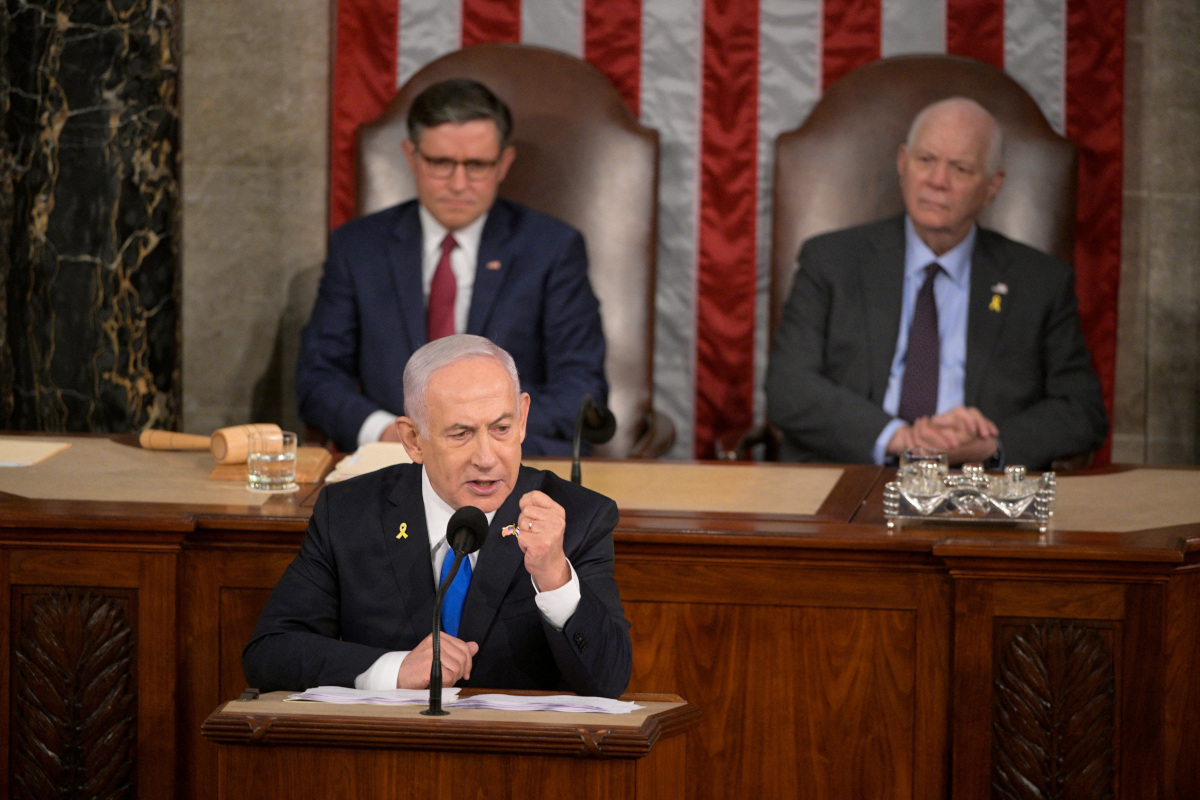
U.S. House Speaker Mike Johnson (R-LA) and Senate Foreign Relations Chair, Senator Ben Cardin (D-MD), listen as Israeli Prime Minister Benjamin Netanyahu addresses a joint meeting of Congress at the U.S. Capitol in Washington, U.S., July 24, 2024. REUTERS/Craig Hudson
Many will quickly notice that looks pretty much like the status quo. Indeed, it seems to not be materially different from the last several ceasefires the US has brokered, and similarly doesn’t offer any timetable for Israel ever withdrawing troops from Lebanon.
Netanyahu insists Israel will remain in Lebanon “as long as necessary,” and Defense Minister Israel Katz similarly said that not only will IDF troops remain within the ever-expanding “security zone” in Lebanon, but that they will have no restrictions on their operations, to preserve “all of the IDF’s achievements in the campaign in Lebanon.”
What those achievements are remains unspoken. The IDF has killed over 4,000 people and wounded some 12,000 others, and has occupied Lebanon up to the Litani River, and in some places beyond that. The UN estimates some 1.4 million Lebanese have been displaced by the war, and Amnesty International says it amounts to an illegal forced population transfer.
Within the Israeli polity, the stances are either to maintain an open-ended war and occupation, or to escalate dramatically, with National Security Minister Itamar Ben-Gvir leading a call to “burn” the entirety of Lebanon, leading to international condemnation. As ever, the chances of Israel agreeing to end the war in the near-term in any meaningful war seem remote.