Israeli Defense Minister Israel Katz talked up the expectation of a new round of fighting with Iran recently, declaring that the “mission is still not complete.” While bellicosity toward Iran is hardly news coming out of Katz, more relevant is the impact it may have on the ongoing Israeli invasion and occupation of Lebanon.
Israel most recently invaded Lebanon in early March of this year, during the early stages of the Iran War. IDF troops have occupied southern Lebanon, broadly everything south of the Litani River as well as some territory between the Litani and Zahrani Rivers.
In new comments, Katz said that not only does Israel intend to main the occupation of Lebanese and Syrian territory indefinitely, but that if the Iran War re-escalates “we are fully prepared to seize additional territory, evacuate local residents and incorporate it into Israel’s permanent security perimeter.”
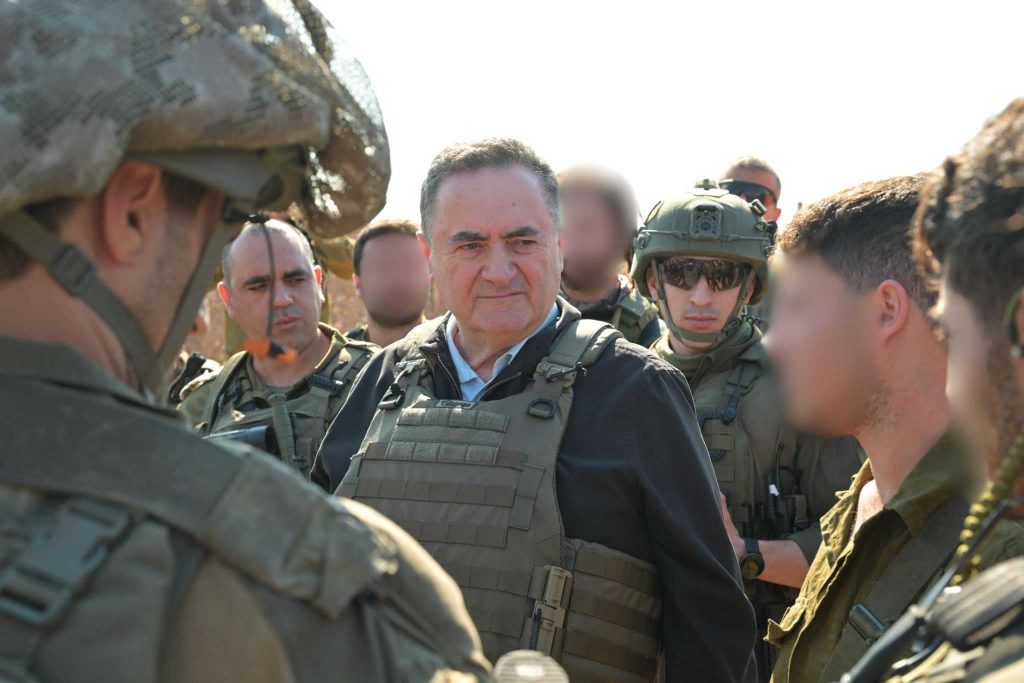
Israeli Defense Minister Israel Katz visits southern Lebanon
The term “permanent” is revealing here, because in all cases, Katz laid out the conditions for occupations, full Hezbollah disarmament, the complete elimination of every single “jihadist” faction in Syria, the total demilitarization of the Gaza Strip. None of those are readily achievable goals, but they are ready-made pretexts for permanent military occupations.
These open-ended occupations are more consequential to the residents of those regions than Katz makes it appear. Israel may call it a “permanent security perimeter,” but in practice their military occupations are overwhelmingly dedicated to expelling certain religious groups from the region, and demolishing civilian infrastructure wholesale.
Last month, Katz bragged that Israel had outright destroyed over 60 villages in southern Lebanon. He added at the time this amounted to 23,000 homes eliminated and 200,000 people permanently displaced from the region.
The underlying narrative is meant to be that the displaced population is overwhelmingly Shi’ites, though in practice Israeli forces routinely attack Sunni and Christian villages in southern Lebanon as well, even if the priority is given to eliminating Shi’ite villages first.
The amount of damage done in the course of this occupation is historically devastating, the talk of reconstruction has been seriously limited, and even that reconstruction is likely to never happen, as the occupation is, Katz will remind us, “permanent.”