While the large number of civilian deaths and the large number of healthcare worker casualties have rightly garnered considerable attention during Israel’s ongoing invasion of Lebanon, the mass displacement of civilians has been relatively under-reported given the sheer scale and the legal implications.
Early in the war Israeli officials bragged about displacing hundreds of thousands of civilians from southern Lebanon and not allowing them to return while the war was ongoing. Only yesterday, the UN noted the displacement was actually substantially higher than that, around 1.4 million or roughly a fifth of the entire population of the country. How we got there is part of the problem though.
Amnesty International, in their latest report, noted Israel has been using evacuation orders against populated areas an inordinate amount of times, and similarly using no-return orders to keep the displaced from coming back home when the situation is over.
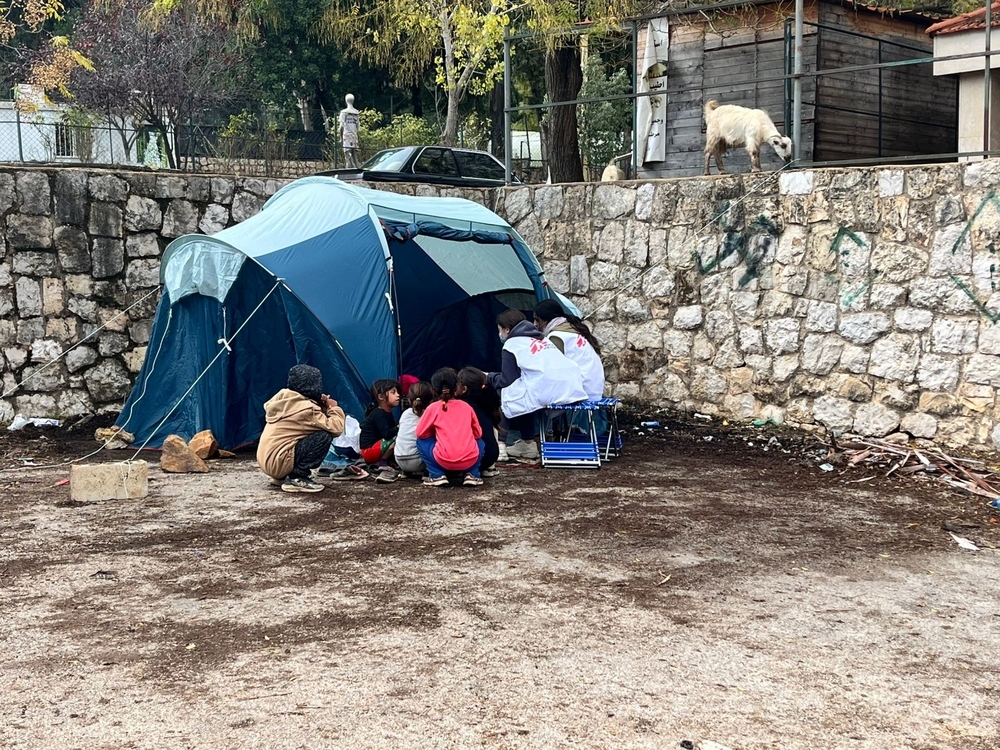
An image of displaced in southern Lebanon during the ceasefire ©MSF
That has not only led to the displaced numbers spiraling, it also effectively amounts to a forced population transfer, a serious war crime under the Fourth Geneva Convention. Since these orders come in the wake of Israel advancing a plan in late 2025 to create a “Trump Zone” out of a forcibly depopulated and militarily occupied southern Lebanon, it’s difficult to argue this is purely unintentional.
It is not uncommon for Israel to issue an evacuation order for dozens of villages any given day, and as the war expands, the number of formal “no return” orders issued has spanned in excess of 6% of Lebanon’s land mass.
That problem is compounded because even if nominally “no return” zones aren’t imposed in a lot of southern Lebanon, Israeli forces have regularly attacked people trying to return, particularly to municipalities that were heavily Shi’ite, and after ordering the populations of towns and cities north of the Litani River, Israel also destroyed all the bridges over those rivers, making return logistics incredibly challenging, even if it’s not strictly disallowed.
In the southernmost parts of the country, Israel has leveled some towns and villages, meaning the displaced will have nothing to return to at any rate, and with Israeli Defense Minister Israel Katz saying those areas are going to remain security zones “indefinitely” and “cleared” of residents, again there’s not much room for plausible deniability.
Not that Israeli officials aren’t trying, of course. Israeli officials were quick to reject Amnesty’s statement, insisting the evacuation orders are only technically “advanced warnings” of imminent attacks and that technically, no prohibition exists on the civilians trying to return to their homes. If that works as a loophole for the Geneva rules against forcible population transfers, then a large chunk of Lebanon’s population is facing an uncertain future indeed.