Another day of intense Israeli attacks across Lebanon has left at least 36 more people killed and 209 others wounded, the majority of them civilians. Though nominally a war against Hezbollah, the attacks are increasingly targeting areas far from the front lines and without even tangential relation to Hezbollah.
One of the attacks, for instance, targeted the Christian town of Saadeh, east of the capital city of Lebanon. The strike targeted an apartment building killing a man and two women. The man was identified as Pierre Moawad, an official in a Christian political party which is known for its outspoken opposition to Hezbollah. Moawad’s wife was also slain in the attack.
Israel’s only comment on the matter was that they carried out an attack on a “terror target east of Beirut” and that reports of “uninvolved individuals being harmed” will be reviewed by Israeli officials.
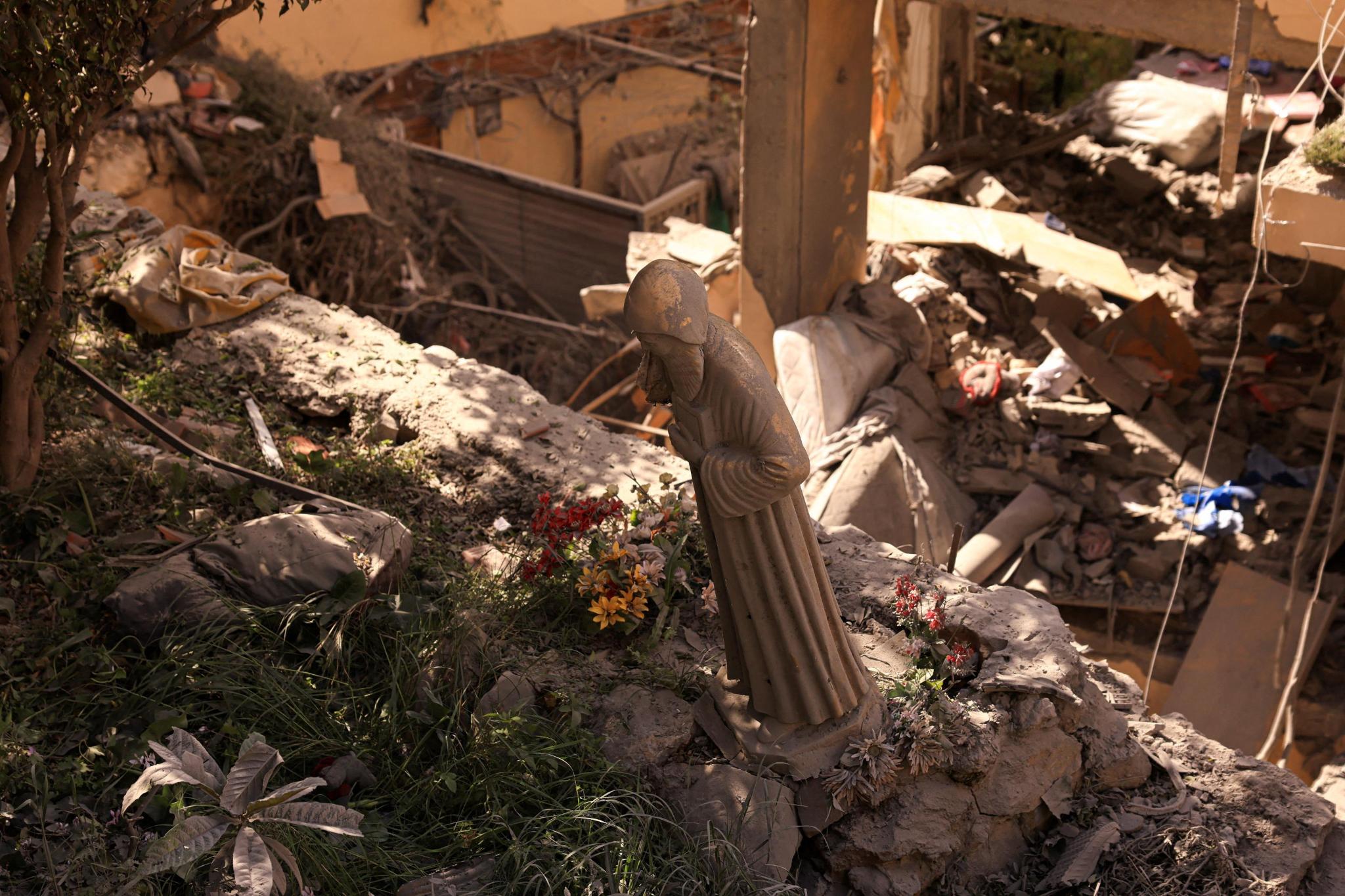
A statue of Lebanese saint Charbel Makhlouf is covered in dust at the site of an Israeli strike on an apartment building as the US-Israel conflict with Iran continues, in Ain Saadeh, Lebanon, April 6, 2026. REUTERS/Raghed Waked
Other attacks killed multiple civilians in southern Lebanon, including two paramedics killed and a third severely wounded in attacks. This brings the number of paramedics killed in the war so far to 57.
The World Health Organization (WHO) has been increasingly critical of Israel’s repeated, deliberate attacks on health care infrastructure across Lebanon, following a weekend attack adjacent to the largest public hospital in Lebanon. The WHO verified at least 92 attacks on health facilities, medical vehicles and personnel.
Israel launched its latest invasion of Lebanon of March 3, in the wake of the US and Israel carrying out a joint attack on Iran. Israeli officials say the current goal of the war is to occupy and control the area south of the Litani River, and ensure that some 600,000 civilians displaced from that area are not allowed to return home. They also intend to level a number of towns and villages in the area, both anything that they consider too close to the Blue Line, and any town they believe Hezbollah was using, which could effectively be anywhere.
In addition to the semi-permanently displaced people in southern Lebanon, Israel has ordered evacuation of a number of areas across the rest of the country, leaving some 1.2 million Lebanese displaced by this war. This has overwhelmed humanitarian groups that both didn’t expect such a large number of displacements outside the active war zone and didn’t expect that so many would be precluded from returning home for the long-term.
Forcible displacement of the population violates the Geneva Conventions and amounts to a crime under international law.