The ceasefire between the Kurdish SDF and the Syrian military seems to be completely in tatters Tuesday, as the SDF General Command called for a full mobilization of their forces amid ongoing attacks by the military on their territory in northeast Syria.
Sunday’s ceasefire was meant to end several weeks of heavy fighting in Aleppo, but seemed to be faltering in less than 24 hours, with the army and their allies attacking Kurdish territory in several sites, notably trying to seize SDF-held prisons full of ISIS detainees.
The Syrian government’s go-to solution for this is to announce yet another ceasefire, though in this case the ceasefire looks more like an ultimatum, with President Ahmed Sharaa giving the SDF four days to agree to the integration of the Hasakeh Governorate under his control.
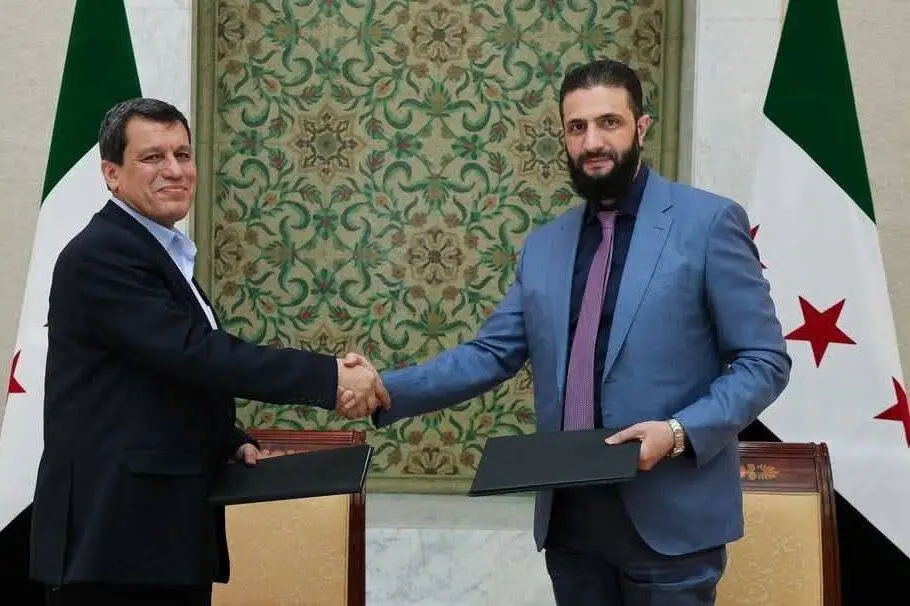
SDF commander Mazloum Abdi and HTS leader Ahmed al-Sharaa meet (image from X)
The SDF, by contrast, seems to be readying forces for the inevitable collapse of yet another ceasefire that’s being wildly feted by the international community, with the current fighting centering on the area around the city of Kobani.
SDF commander Mazloum Abdi says that the group will be falling back to Kurdish-majority areas of the country, which includes the area around Kobani as well as the northeast, and will defend them as a “red line” and resist attacks on those areas.
Syrian officials are trying to portray the Kurds as uniquely intransigent about the diplomacy surrounding integration talks, which are both an attempt to shift the blame for the fighting entirely onto the SDF and a justification for the four day “ceasefire” and its inevitable collapse.
US Envoy Tom Barrack is loudly on board with forcibly integrating the Kurds into Syria, repeatedly declaring that federalism “doesn’t work.” Today, he doubled down on that position, declaring that the SDF’s mission is over and they must integrate.
Given the amount of violence against other minorities in Syria, and the repeated attacks on the Kurds themselves within Syria, many aren’t hopeful that integration will be peaceful. That fear extends internationally, with Iraqi Kurds in particular rising up to protest against the attacks on their Syrian brethren.
Kurdish protesters rallied at multiple locations, including the US Consulate in Irbil, where the position was that the US, as historic allies to the SDF, should be supporting them instead of arguing in favor of dismantling them outright.
Though the largest demonstrations were in Iraq’s Irbil and Sulaymaniyah, other rallies were reported elsewhere where a Kurdish population lives, including Beirut, Paris and London. In Europe, the rallies were more generally in support of the Kurdish-dominated Rojava autonomous regional government, which the Syrian government also intends to dismantle once they resolve the resistance of the SDF.