Hezbollah historically has fit in an unusual position in Lebanese politics, being a substantial Shi’ite political party as well as a substantial Shi’ite militia that was centered on resisting Israeli military intervention on Lebanese territory. Those statuses are coming into focus again as Israel ramps up its latest war against Lebanon.
Lebanese Prime Minister Nawaf Salam has announced a full ban on all military and security activity by the Hezbollah movement, citing major Israeli attacks across Lebanon and insisting that Hezbollah restrict itself entirely to the political sphere.
Hezbollah launched rockets against Israel over the weekend, citing ongoing Israeli military activity against Lebanese territory as well as the assassination of Iranian leader Ayatollah Ali Khamenei. Whether Hezbollah can be expected with this new ban to simply not retaliate as the war further escalates remains to be seen, but that appears to be the intent.
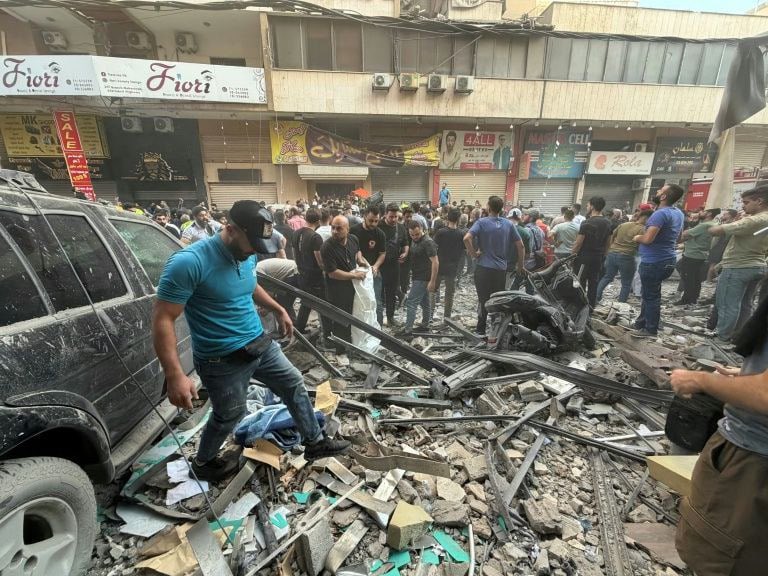
Aftermath of strikes in Dahiyeh | image from X
These were the first rockets fired by Hezbollah at Israel since the ceasefire went into effect in November of 2024. Israel, by contrast, fired over 1,000 distinct strikes at Lebanese territory since the agreement.
Salam insisted that the decisions surrounding war rest solely with the Lebanese state, and ordered the Lebanese military to enforce his decision. He also presented this new ban as an opportunity to forcibly disarm Hezbollah “immediately and firmly.”
Salam has long sought to disarm Hezbollah nationally, and while the group cooperated with disarmament in the south, under the terms of the 2024 ceasefire with Israel, they have rejected disarmament elsewhere in Lebanon, citing the ongoing military actions by Israel as something they need to be prepared to resist.
Israel had also demanding that full disarmament for some time, but the latest indications are that it would no longer be sufficient to end the Israeli war at any rate, with Israeli officials reportedly now demanding that Lebanon declare all of Hezbollah a “terrorist group” and disband them entirely as both a militia and a political party.
The threat is that Israel will attack the Lebanese international airport, their ports and other civilian infrastructure targets if the government doesn’t capitulate to these latest demands. It’s not clear what legal process exists whereby Salam could outlaw a political party on the basis of foreign military demands.
It would also greatly complicate Lebanese politics if such a ban were possible, as Lebanese politics are split along sectarian lines, and Hezbollah’s bloc is one of only two meaningful Shi’ite political parties. The Amal Movement, the other party, is often aligned with Hezbollah on political issues and it’s not clear if the Israeli demand to ban Hezbollah from politics would grant Amal a de facto monopoly among Shi’ite voters, or presume them to be banned as well for being Hezbollah-adjacent.