Former Iraqi Prime Minister Nouri al-Maliki’s candidacy to return to the position was meant to have been vetoed last month by President Trump, who denounced Maliki as “insane” and threatened to withhold all US support if he returned to office. There was talk of a Sunday ultimatum for him to step down.
Monday morning, Maliki remains the State of Law Coalition’s candidate, and appears to still have the Coordination Framework’s approval, at least for now. The framework is expected to meet Monday evening to discuss the matter, but deep divisions suggest they are unlikely to agree to strip Maliki of the candidacy just because President Trump is demanding it.
Maliki remains defiant as ever, saying that out of respect for Iraq’s sovereignty he will not withdraw from the candidacy just because a foreign leader demands it. He did, however, acknowledge that he believes a good relationship with the US is “essential for Iraq’s progress.”
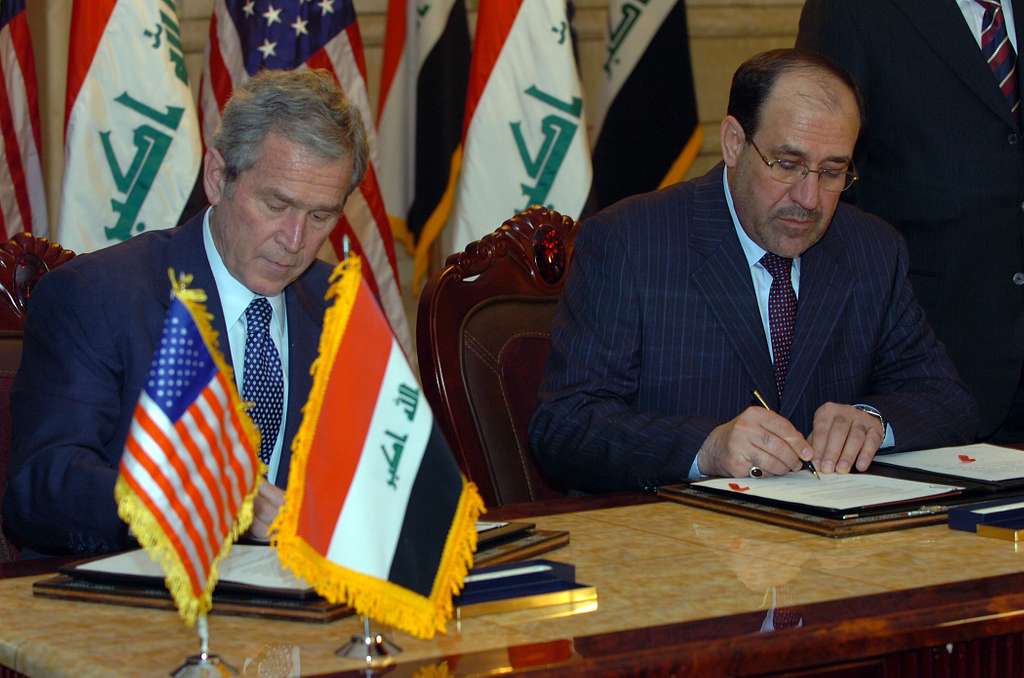
Which is a complicating factor, as it’s difficult to argue that the Iraq has ever had a good relationship with the US since the 2003 invasion and occupation. What it has had is a bunch of new financial arrangements which give the US unreasonable power over Iraq’s economy and, in the interpretation of the current US administration, de facto veto power over their government.
Iraq’s oil revenue is functionally the government’s entire budget, and that revenue is arranged so that it is deposited in held at the New York Federal Reserve Bank. President Trump has used that fact as leverage, threatening to cut off Iraq’s government from its revenue if it displeases him. In 2020 that meant threatening to do so if they asked the US occupation forces to leave, and in 2026 that means threatening to do so if Maliki, or anyone else he doesn’t like, comes to power.
How absolute the power of the US president to dictate terms to Iraq is remains largely untested, but it was presumed a month ago that when he said Maliki couldn’t return to power that was the end of his candidacy. Yet he’s still there, and it’s less that Iraqi coalitions are enamored with him than that there isn’t much in the way of an alternative, and doing it just because Trump wills it so would have implications for how the international community views Iraq.
Maliki is keen to try to reassure US officials in general, if not Trump in particular, that his candidacy is no real threat. He presented his plans for a new term in office as largely in line with America’s own agenda toward Iraq, which includes having the central government gain a full monopoly over weapons, and for political parties to lay down the arms of their affiliated militias.
That is among the goals of the US, though in practice Maliki’s own State of Law bloc has had substantial ties to the Popular Mobilization Forces (PMF) paramilitaries, which are the primary source of US ire because they are Shi’ite and therefore seen as necessarily in league with Iran.
How much of this amounts to the US threatening Iraq over Maliki’s candidacy though, and how much of this is just Trump threatening them on a personal basis isn’t entirely clear, nor indeed is it clear what the difference would be in 2026. Iraq’s constant struggle with forming coalition governments after elections though, likely means they can’t simply dismiss a candidate with even an outside shot at forming a government, no matter who objects.