Approaching the one year anniversary of the massacre of Alawite civilians by a faction including government forces, more details are emerging about what happened to civilians, particularly women, caught up in this violence.
An investigation by the BBC looked into reports of Alawite women who were abducted from the Alawite homelands in Syria’s coastal northwest and taken inland into the Idlib Governorate and elsewhere, where they were subject to beatings and abuse.
“Some are raped and sent back to their families, and others are sold,” one of the abducted women reported being told by the wife of her captor. The exact extent of this kidnapping and selling of women may never be fully known, as the government is insisting it simply isn’t happening and never did.
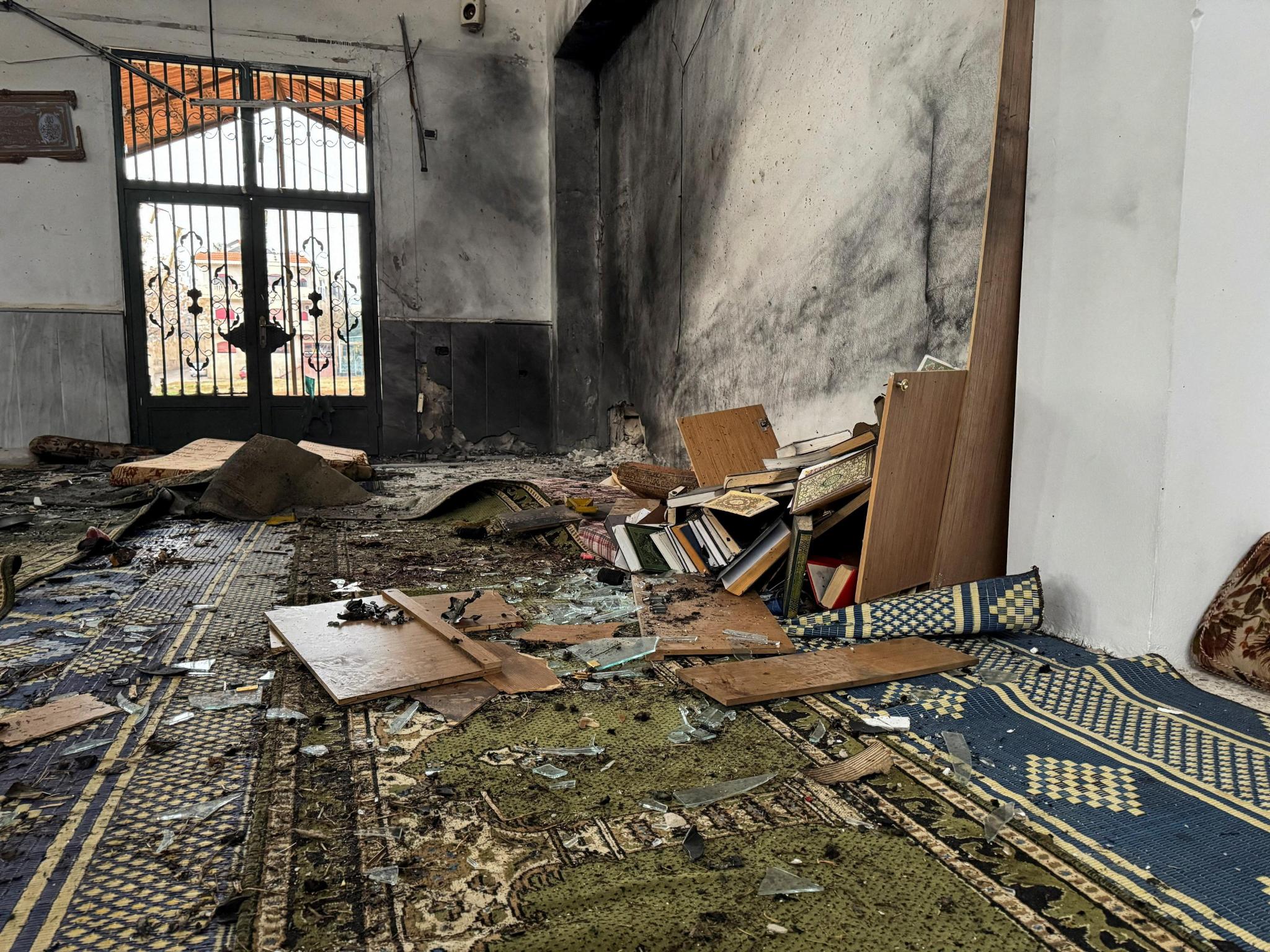
A view shows an interior of a damaged mosque after several people were killed in an explosion at a mosque of the Alawite minority sect in Homs, Syria, on December 26, 2025. REUTERS/Ali Ahmed
Indeed, Foreign Minister Asaad Shaibani insists the massacres didn’t happen either. In comments last weekend in Munich, Shaibani made headlines by declaring that “there is no violence against minorities in Syria,” and also that it “never happened in the past.”
The breadth of that claim is absolutely staggering, as in the roughly 15 months the Hayat Tahrir al-Sham (HTS) has been in power, multiple well-documented massacres of religious minorities have taken place, and Syrian Interior and Defense Ministry personnel have been implicated in those massacres.
While the massacre of Alawites took place in March of 2025, the violence has continued against them to this day, with the Syrian Observatory for Human Rights reporting two more Alawite men killed in recent days in Latakia and Homs.
Shaibani presents the entire problem Syria has as some factions having arms being outside direct HTS control. This has been an ongoing policy goal for the HTS to claim full monopoly over force across the entire nation. Given HTS’s al-Qaeda-affiliated past and the reality of modern Syria being rife with religious and ethnic minorities, it is perhaps unsurprising that many are bristling over this attempt at control, and seeing their own disarmament as a prelude to further massacres, which will doubtless be similarly denied by Shaibani and others.