Iraq had a parliamentary election in late 2025, with the results ratified in mid-December. This, as usual, led to a scramble to try to form a majority coalition out of a large number of political parties that gained meaningful seats in a situation where the plurality was only 11.74%, far short of the ability to form a government without a slew of partners.
This is always a challenge, and involves a lot of internal compromise over cabinets and coalition structure. The US, however, is making this dramatically more challenging by threatening to withhold materially all of Iraq’s oil revenue from the Iraqi government if the coalition isn’t to their satisfaction.
The US is able to do this, because in post-occupation Iraq, their oil revenue is held in US dollars at the Federal Reserve Bank of New York, right where the US can easily get at it or restrict its transfer to the Iraqis whenever the mood suits them.
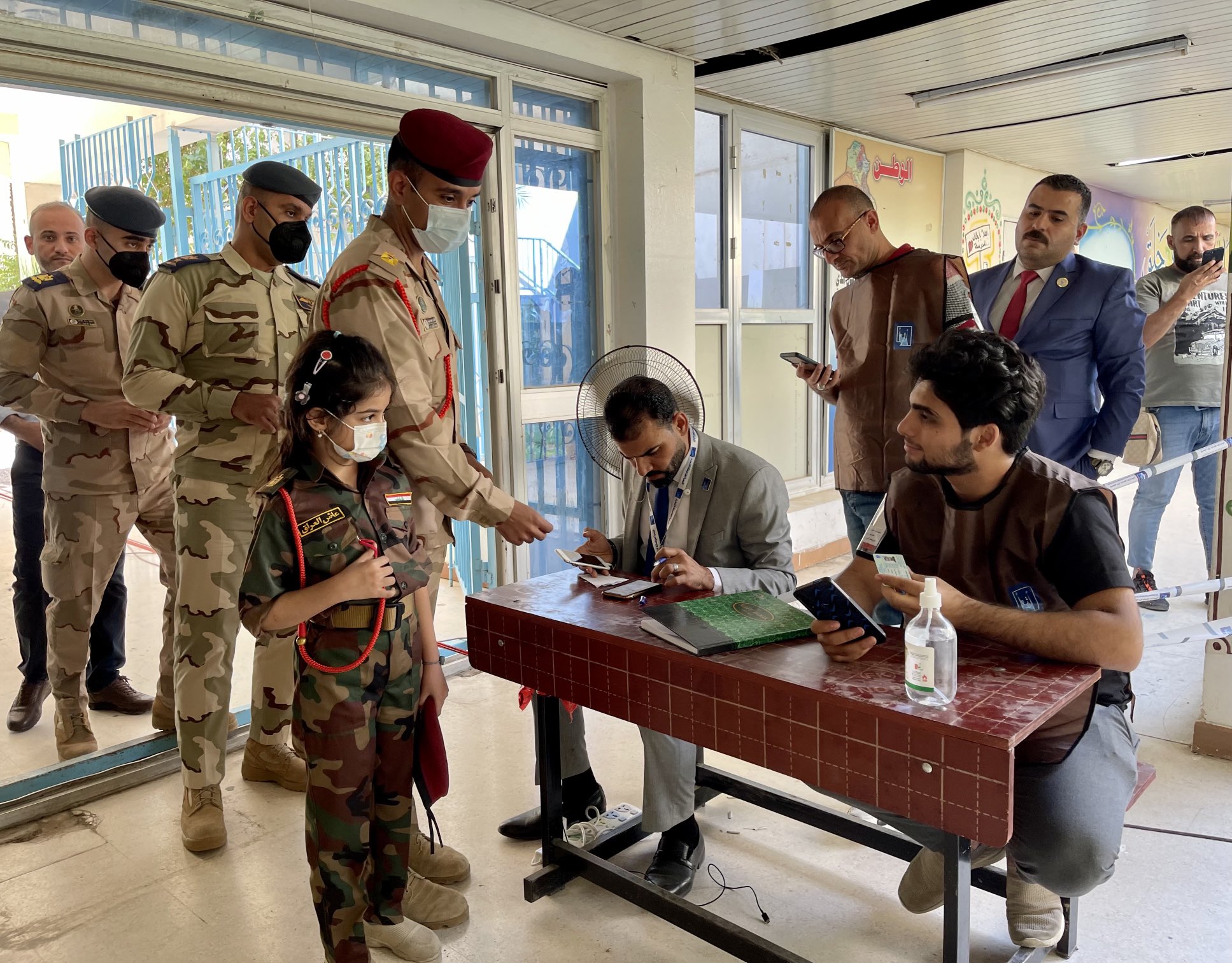
Iraqi security forces vote in an election | Image from X
Shi’ites have a majority of the seats in Iraq’s parliament in practice. That’s no surprise as they are the majority of the population. Carving out a coalition of Shi’ites is easier said than done, however, because many of the parties are at odds with one another. Adding to that, the US has decided that Shi’ite parties that are still aligned with armed factions are “Iran-backed” and therefore “incompatible with building a strong partnership between the United States and Iraq.”
In practice this means that the threat is if the government includes any of the Shi’ite blocs which the US considers “Iran-backed” then Iraq will immediately lose all of its oil revenue for displeasing the US.
It’s a bigger problem then it seems on the surface, because the major Shi’ite blocs almost all have some ties with militias in some form or another. The expectation had been that the State of Law Party might parlay their 6% vote and fourth place finish into a return to power for former premier Nouri al-Maliki. Controversial given Maliki’s past, it is also seemingly impossible to argue that State of Law isn’t aligned with armed factions.
A lot of big parties have some ideological and practical ties to the Popular Mobilization Units (PMU), which are Iran-backed and while nominally integrated into Iraq’s own military, it’s almost impossible for any meaningful Shi’ite faction to not have any ties to them.
The PMU were historically scores of smaller militias, generally Shi’ite, generally Iran-aligned, and they merged over a decade ago to counter the rise of ISIS, which seemed convenient at the time, but which the US now seems to see as politically unpalatable.
This is not the first time the US has threatened to use their de facto control over Iraq’s oil revenue to coerce them. In 2020 after the assassination of Qassem Suleimani, Iraq threatened to expel US forces from Iraq in protest, and President Trump at the time threatened to seize their oil revenue in retaliation if they did so.
Despite the talk of a “strong partnership” with the United States, the US hasn’t even appointed an ambassador to Iraq, and is seemingly running their relationship through wild diktats backed by the threat of bankrupting Iraq because their revenue stream is stored in the US Federal Reserve. While that banking relationship may have been convenient in the early years of US occupation and post-war reconstruction, it is now clearly a massive liability for Iraq, and one that future Iraqi governments, assuming one can be formed at all, will need to revisit if they want to have any meaningful autonomy.