Sunday’s ceasefire between the Syrian military and the Kurdish SDF lasted less than 24 hours, following a lot of their recent ceasefires in giving way to immediate new rounds of fighting in the Raqqa Governorate, this time centering on the al-Aqtan Prison.
The al-Aqtan Prison, in Kurdish territory, is one of several prisons at which ISIS detainees have been held since the civil war. Though there had been talk of relocating the prisoners someplace more secure as part of the integration deal between the Kurdish regional government and the Syrian central government, the Syrian military advanced quickly on the prison and aimed to seize control of it.
Fighting has been reported for hours, with the SDF reporting 9 of their forces killed and 20 wounded. The Syrian military reported three soldiers were slain as well, though their statement did not make it clear if they were specifically killed in the prison fight, or in some of the other assorted battles that have started around the area.
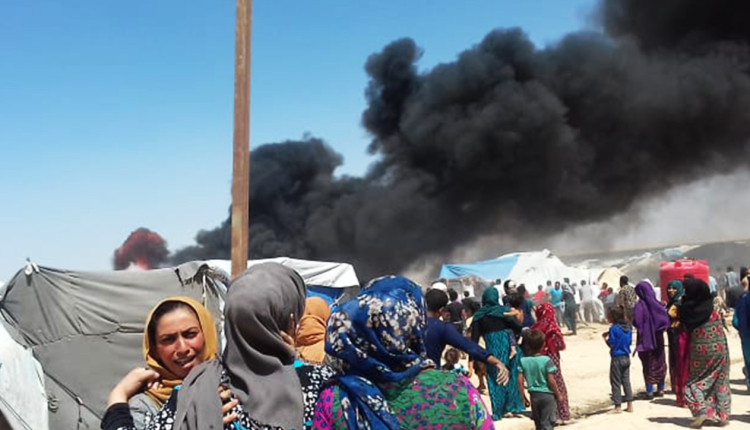
A Red Crescent center burns in al-Arishah Camp in Hasakeh | Image from SOHR
One of the SDF’s other ISIS prisons, in Hasakeh Governorate, also reportedly came under attack by unspecified armed groups. The Syrian military denied involvement, and accused the SDF of secretly releasing some of the ISIS fighters at that prison for some reason. They vowed a military operation would recover any missing ISIS detainees, and put them under the control of the Interior Ministry.
The accusation of the SDF releasing ISIS prisoners seems to be a pretext to attack the other prisons, and seems to be escalating the violence against SDF-held locations across the country, In Hasakeh Governorate, a Red Crescent location was looted and burned by armed tribal fighters reportedly aligned with the government.
Fighting was also reported in the area of the city of Ayn Issa, in northern Raqqa Governorate, and the nearby village of Abu Srah. The reports are that SDF forces in that area came under fire from factions aligned with the central government as well.
The territory changing hands in Syria as a result of the last two weeks of fighting is having spillover consequences as well. Shell Oil has reportedly requested a deal that would see them withdraw from operations at Syria’s al-Omar Oil Field, which was under Kurdish control but seized by the central government in the ceasefire deal.
Neighboring Iraq also sees potential danger from the amount of changes in Syria, saying they are boosting security at the border for fear of spillover violence. The danger of ISIS fighters escaping is likely a major source of concern in that case.
Turkish Kurds see a potentially far bigger problem with this collapsing of relations between Syrian and Kurdish officials across the border, with PKK leader Abdullah Ocalan saying he views the situation in Syria as an attempt to “sabotage” the peace process in Turkey as well.
The PKK had warned the Syrian fighting called into question the ceasefire deal within Turkey, and given Turkey’s eager backing of new Syrian government attacks on the Syrian Kurds, how committed they are to respecting their own ceasefire is inevitably brought into question.