Iran’s foreign minister warned Arab neighbors on Thursday not to do Washington’s bidding in the escalating controversy over U.S. sanctions and Iran’s threat to close the Strait of Hormuz.
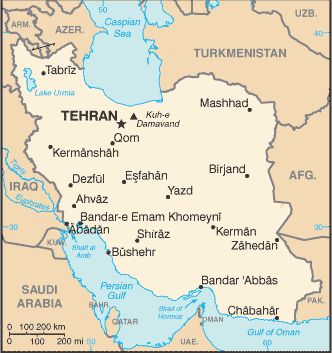 The U.S. has been pressuring its allies to place additional economic sanctions on Iran’s oil and banking sectors. After suffering from economic warfare and international aggression primarily from the U.S. and Israel, Iran has frantically issued threats to close the Persian Gulf’s Hormuz waterway, through which a third of the world’s seaborne oil passes.
But Iran’s Sunni Arab rivals in the Gulf states have sided closely with the U.S. in Washington’s quest to isolate Iran for its non-existent nuclear weapons program. Saudi Arabia recently announced that it could quickly raise oil output for key customers if they join the embargo on Iranian oil.
“We want peace and tranquility in the region. But some of the countries in our region, they want to direct other countries 12,000 miles away from this region,” Iranian Foreign Minister Ali Akbar Salehi said recently. “I am calling to all countries in the region, please don’t let yourselves be dragged into a dangerous position.”
The rivalry between Shiite Iran and the Sunni Arab states in the Gulf region has been exacerbated for decades by Washington’s assertive support for many of those tyrannies, who then establish policies conforming to Washington’s interest in exchange. Many Arab leaders have even advocated a U.S. military strike on Iran.
These regional tensions are increasing primarily due to aggressive U.S. and Israeli postures towards Iran for its alleged nuclear weapons program. But there is no evidence of an Iranian nuclear weapons program, and the opinion of the U.S. intelligence community, privately the Obama administration, and the latest IAEA report is that Iran’s enrichment is so far civilian in nature.