The Senate narrowly defeated a War Powers Resolution on Thursday that would have directed President Trump to end the war with Iran, though the vote doesn’t negate the Iran War Powers Resolution that was passed by both the Senate and the House several months ago.
The resolution failed Thursday in a 49-50 vote, with four Republicans — Senators Rand Paul (R-KY), Lisa Murkowski (R-AK), Susan Collins (R-ME), and Thom Tillis (R-NC) — supporting the measure. It marked the first time Tillis, who is not running for re-election, voted to end the war.
Just one Democrat, Senator Jon Fetterman (D-PA), voted against the bill, something he’s consistently done, and Sen. Angela Alsobrooks (D-MD) wasn’t present for the vote. If Alsobrooks did vote in favor of the resolution, Vice President JD Vance could have cast a tie-breaking vote to kill the bill, as he did with a Venezuela War Powers Resolution earlier this year.
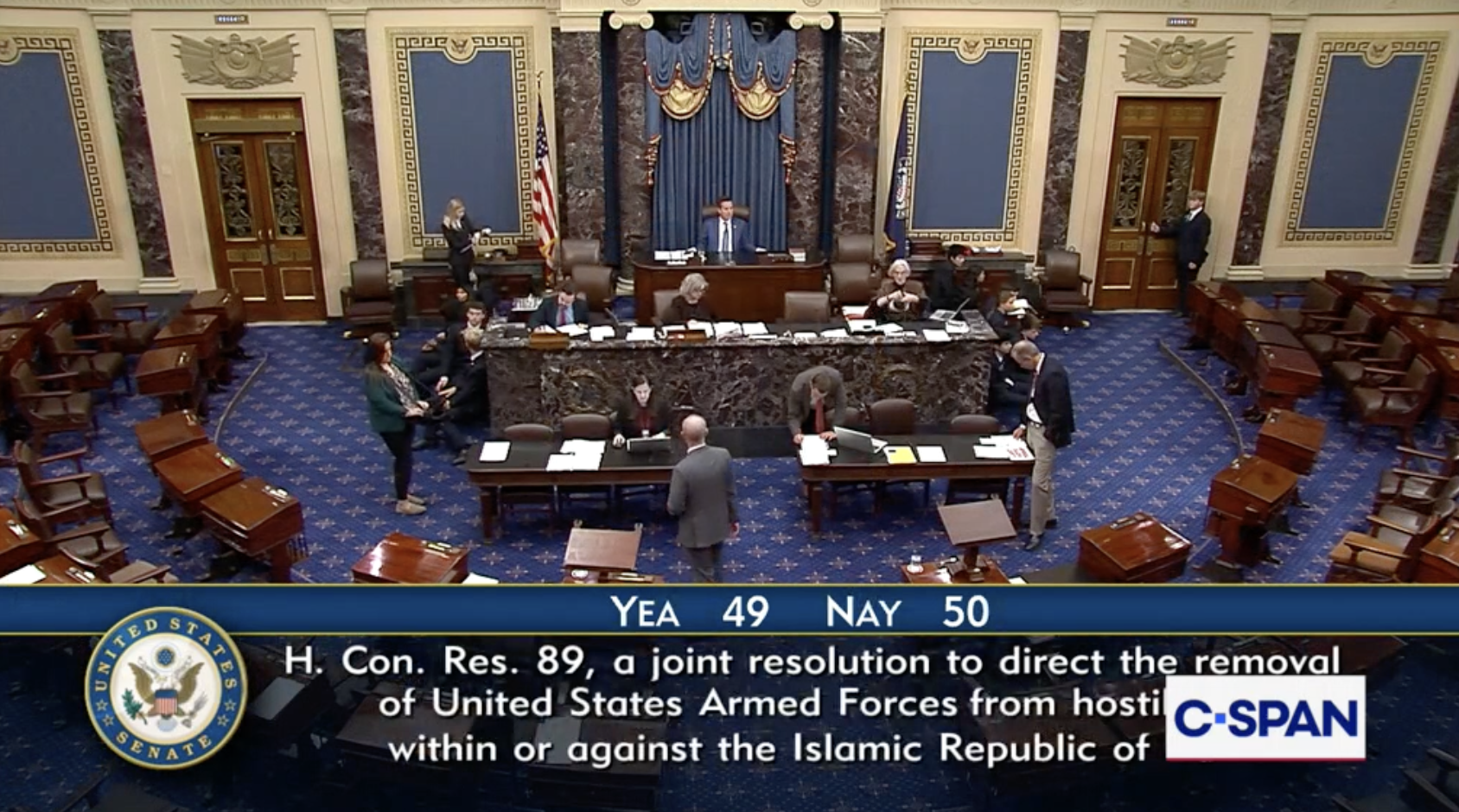
The resolution previously passed through the House, where seven Republicans voted in favor, the most support from the GOP that a bill to end the Iran war has received.
Back in June, both the House and the Senate passed a concurrent War Powers Resolution directing President Trump to end hostilities against Iran, marking the first time Congress has approved a concurrent resolution under the 1973 War Powers Act directing the termination of an unauthorized war.
Section 5(c) of the 1973 War Powers Act states that “at any time that United States Armed Forces are engaged in hostilities outside the territory of the United States, its possessions and territories without a declaration of war or specific statutory authorization, such forces shall be removed by the President if the Congress so directs by concurrent resolution.”
Thursday’s vote, or any of the other recent War Powers bills that have been defeated, does not repeal H. Con. Res. 86, the resolution that was passed in June. Rep. Thomas Massie (R-KY) has said in his articles of impeachment that he introduced for Pete Hegseth that the Pentagon chief is in violation of the 1973 War Powers Act by continuing the war with Iran without congressional authorization. Massie also argues that the war was unlawful from the outset because Congress never declared war on Iran or provided authorization for the hostilities.