On March 30th, the Selective Service System (SSS) sent the White House its proposed regulations for “automatic” [sic] draft registration for review and approval before they are made public. This is the first visible step in the transition from trying to get young men to sign themselves up for a military draft, to trying to sign them up “automatically” by aggregating data requisitioned from other Federal agencies.
This year-long process began with the enactment of the SSS proposal for “automatic” registration in December 2025. The new scheme is supposed to go into operation in December 2026.
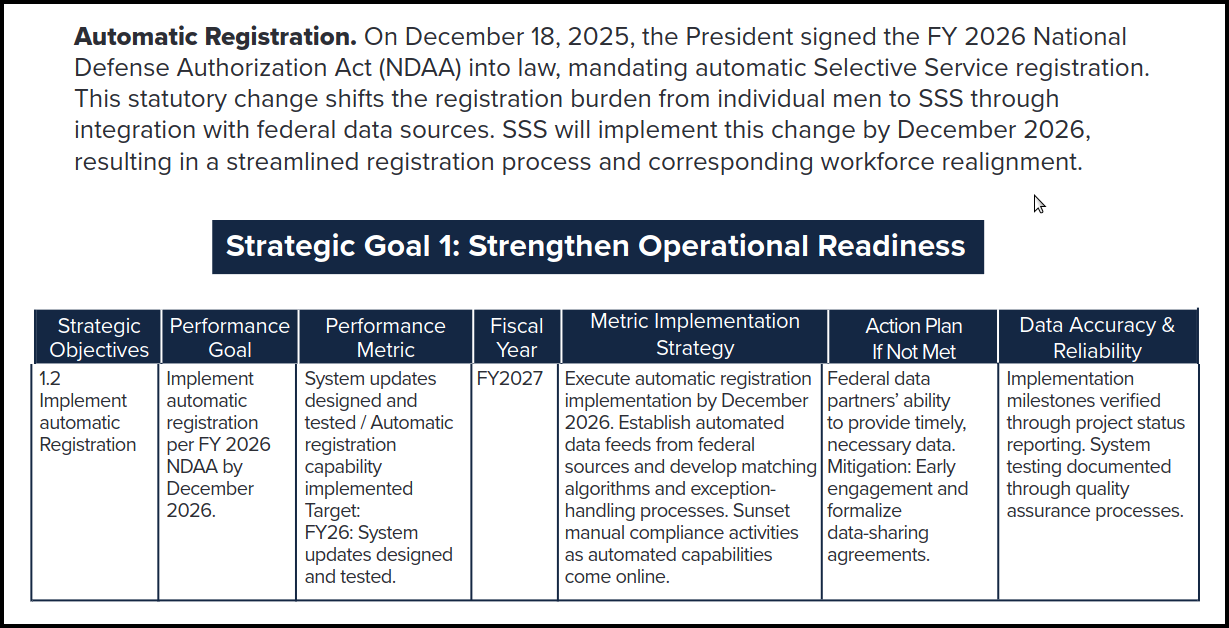
[Excerpt from Selective Service System FY 2026-2027 Annual Performance Plan]
This isn’t a Trump 2.0 initiative. Documents released in response to one of my FOIA requests show that the legislative proposal for “automatic” draft registration was drafted during the Biden Administration by the former Trump 2016 Oregon state campaign director, Jacob Daniels. Still at the SSS today, Daniels is one of the Trump loyalists who got jobs at the SSS during Trump’s first administration. But both support and opposition to Selective Service has been and remains bipartisan.
Most of the latest news articles have said that all male U.S. citizens and residents “will be registered automatically” by the SS. What they should say is that the SSS will try to identify and locate all potential draftees. Whether that is possible, much less whether the SSS will succeed, is questionable.
In addition to the practical problems of determining who is subject to the draft (which is many cases depends on factors absent from existing Federal records) and their current postal mailing addresses (ditto), the switch to a new registration system requires jumping through many regulatory hoops. The eight months remaining before the new law takes effect aren’t much time to complete this process.
The law directing the SSS to try to register potential draftees “automatically” leaves most of the details to the SSS to establish through regulations. The SSS has completed the first step in this process by drafting proposed regulations and submitting them to the White House “Office of Information and Regulatory Affairs” (OIRA). OIRA has up to 90 days to review the proposed rules, approve them, or send them back to the agency for revision, but most OIRA reviews take significantly less time than this.
Once a proposed rule is approved by OIRA, the Administrative Procedure Act generally requires publication of the proposed regulations as a “Notice of Proposed Rulemaking” (NPRM) in the Federal Register, a window usually of at least 30 or 60 days for the public to submit comments on the proposal, and consideration of those comments by the agency before it publishes a final rule.
The NPRM for “automatic” draft registration could be published in a few weeks, or not for months.
The SSS is a tiny agency being given unprecedented authority to demand access to data from all other Federal agencies. The attempt to register potential draftees “automatically” will be a large, complex exercise in data collection, data sharing, and data matching between the SSS and other agencies.
Multiple elements of this process will require notice and comment and/or other approvals pursuant to the Privacy Act, Paperwork Reduction Act, and Computer Matching Act.
The SSS has a history of disregard for these requirements for notice, comment, and approval of its data collection, use, and sharing. If the SSS fails to promulgate the required notices or obtain the required approvals for “automatic” registration, those failings may provide a basis for lawsuits against the SSS.
The Privacy Act of 1974 requires each Federal agency to publish a notice in the Federal Register (with an opportunity for public comment) including specific information about each of system of records about U.S. citizens or residents. The notice must include the sources, recipients, and uses of the data. Maintaining such a system of records without first publishing a complete notice is a crime on the part of the responsible agency officials or employees. “Automatic” registration will require new sources of registration data from other agencies and therefore a revised Privacy Act notice.
Even before the start of “automatic” registration, the SSS gave DOGE access to the registration database in early 2025, and in late 2025 proposed sharing its registration data with more other agencies for immigration enforcement and other purposes.
Objections to that proposal were submitted by anti-militarist, civil liberties, and privacy organizations. It’s not clear whether those objections have been considered yet by the SSS.
The Paperwork Reduction Act requires an agency to publish first a 60-day notice and then a 30-day notice in the Federal Register and then get approval from the Office of Management and Budget (OMB) before collecting information from members of the public. The OMB approval number must be included on any form, Web site, or app through which information is collected.
The SSS has been collecting information for decades through its “Request for Status Information Letter” form, but has never requested or received approval from OMB for this form. The form does not display an OMB control number, making it flagrantly illegal.
The “automatic” registration law allows the SSS to demand information from a registrant if it is needed to complete their “automatic” registration. The new forms and/or Web pages to be used for this purpose will need to be published for comment and will then need OMB approval. Because of the two required notice-and-comment periods, this process takes at least three months.
The Computer Matching and Privacy Protection Act of 1988 requires advance notice in the Federal Register, a Privacy Impact Assessment, due-process procedures for individuals who are denied benefits on the basis of data matching, and an annual cost-benefit review and report to Congress for each data matching program by a Federal agency that is used to determine eligibility for, or compliance with, any Federal benefit program.
The SSS has argued that this law didn’t apply to any of its activities, at least prior to the attempt at “automatic” registration. None of the Computer Matching Act notices required annually for each daat matching program have been published by the SSS in the Federal Register since 2017.
New and expanded computer matching programs will be central to the attempt to register potential draftees “automatically”. These programs will be subject to the Computer Matching Act. It remains to be seen whether the SSS will continue to ignore this law even as it dramatically expands its computer matching programs.
Meanwhile, there’s still a chance for Congress to recognize its mistake and avert this impending fiasco by repealing the Military Selective Service Act (MSSA) before the attempt at “automatic” registration begins. The Selective Service Repeal Act could be reintroduced as a standalone bill, and/or proposed as an amendment to the NDAA for Fiscal Year 2027. The NDAA will probably be enacted by the “lame-duck” Congress in late 2026, after the elections but before new members of Congress are seated.
“Automatic” registration was enacted with no public awareness, hearings, debate, or budget review. It’s a bad idea, and it won’t work. The chances for repeal of the MSSA may depend on how soon and how widely “automatic” draft registration is recognized as not only bound to fail but a data grab for DOGE and an enabler of more aggressive war planning and policies.
The task of anti-draft awareness-bulding, mobilization, and action is increasingly urgent and important in the face of new military escalations. Repeal of the MSSA should be on the agenda of all anti-war organizations and a demand raised at all anti-war actions.
Edward Hasbrouck maintains the Resisters.info website and publishes the “Resistance News” newsletter. He was imprisoned in 1983-1984 for organizing resistance to draft registration.