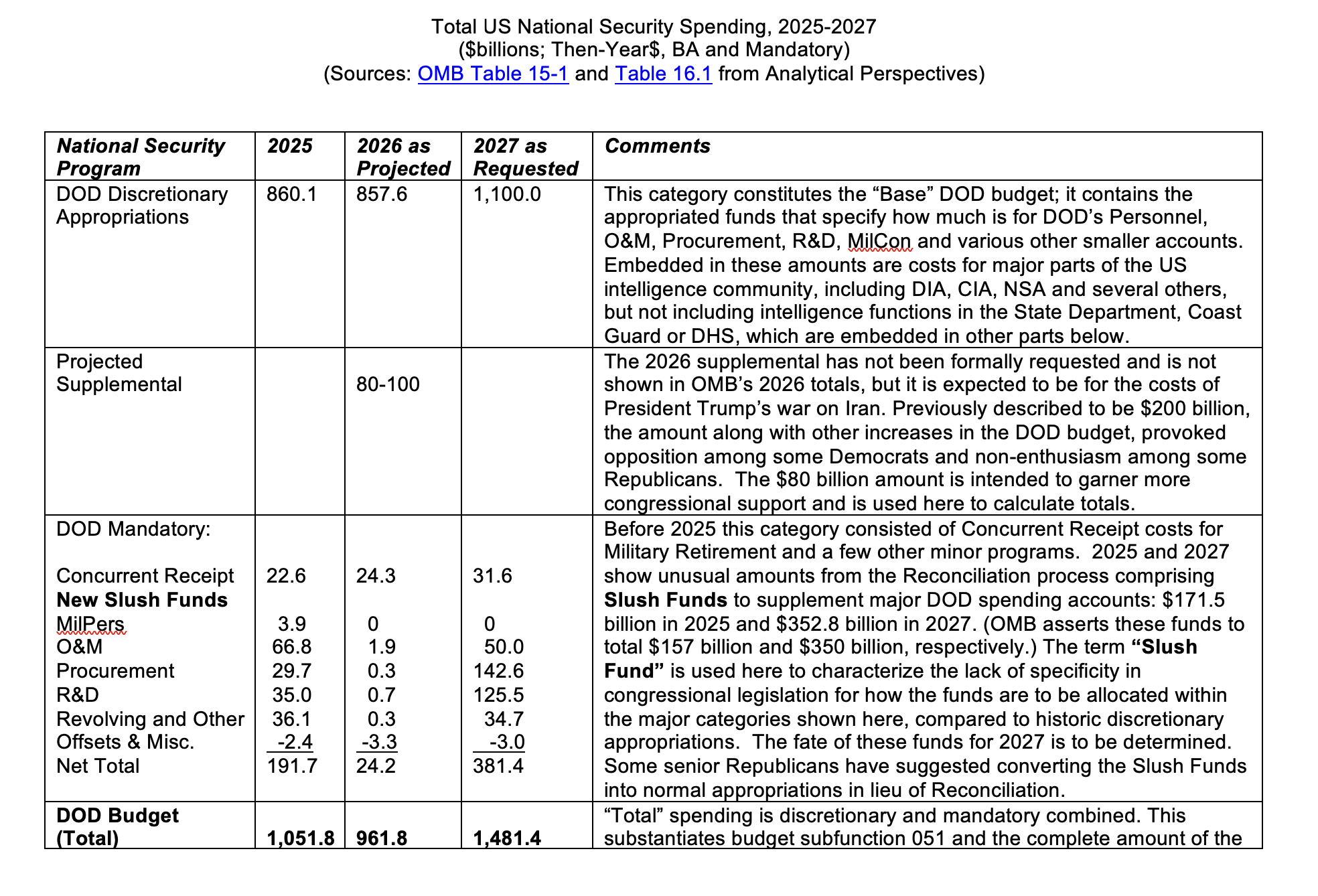
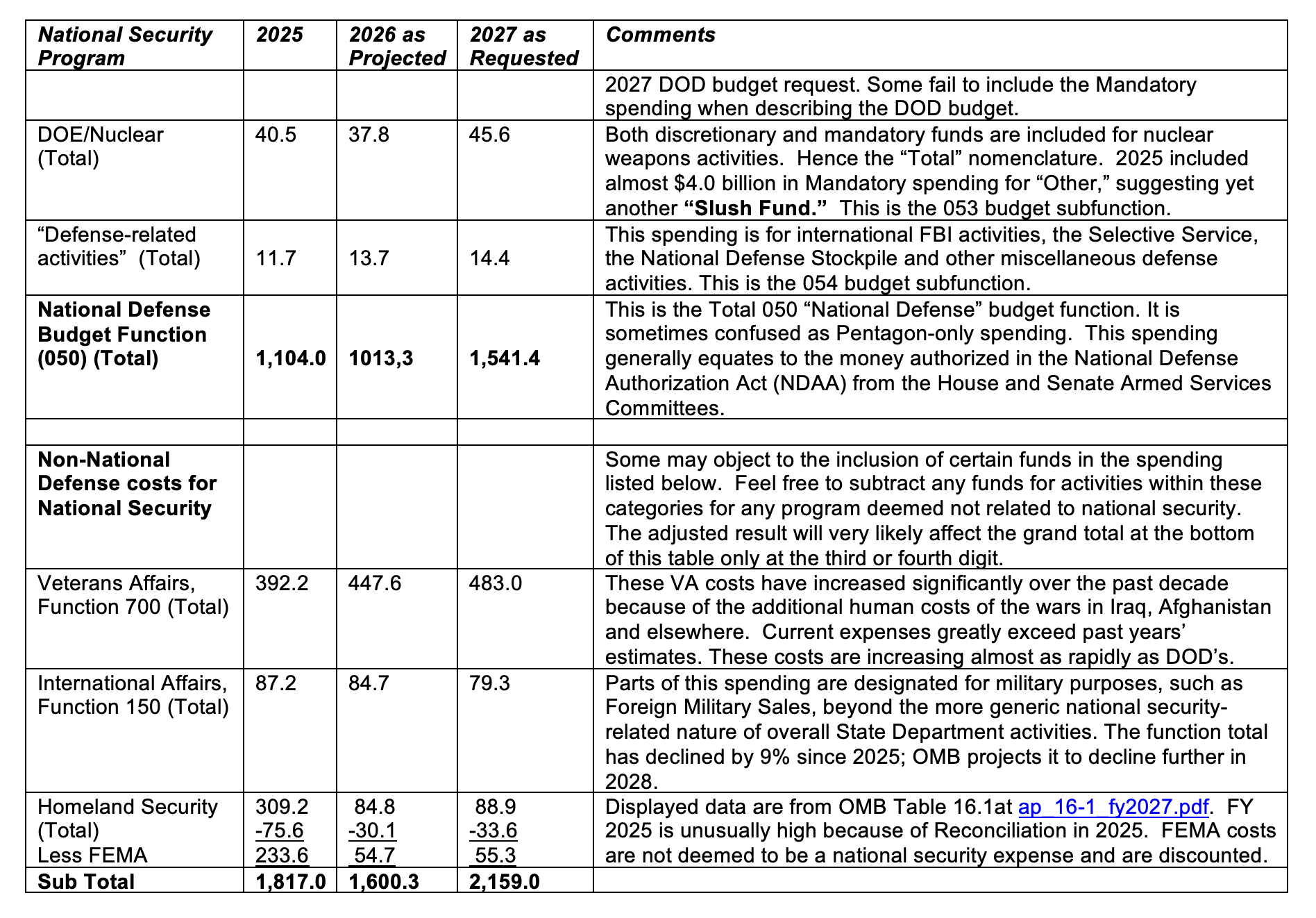
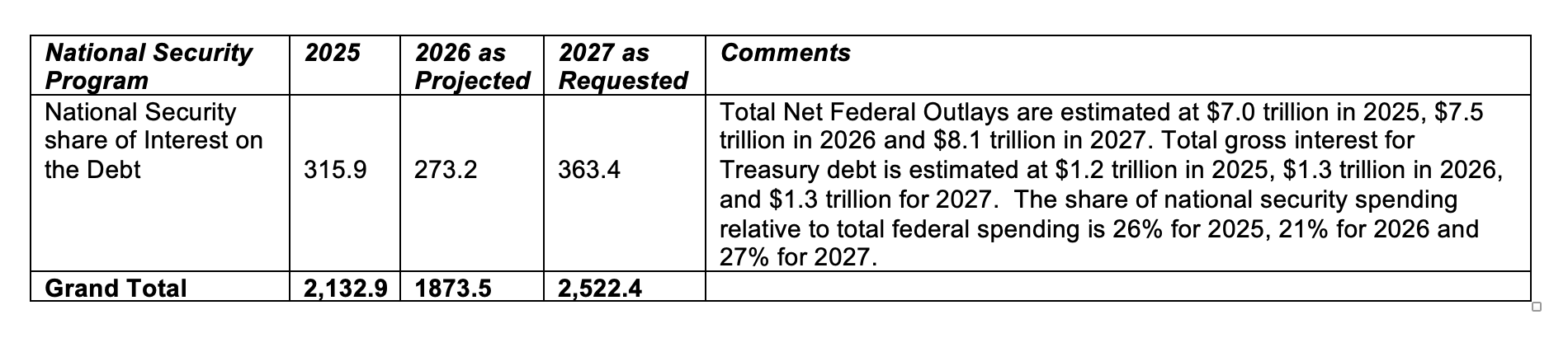
The true total of US national security spending in 2027 will exceed $2.5 trillion, far beyond the already record-shattering $1.5 trillion military budget President Trump has requested, according to veteran defense analyst Winslow Wheeler.
Wheeler, who spent decades working in Washington for senators and the Government Accountability Office on national security issues, reached the figure by factoring in the Pentagon budget, military-related spending from other US government agencies, the national security share of interest accrued on the US debt, among other factors (full table of his work at the end of the article).
The White House’s Office of Management and Budget (OMB) has said that the $1.5 trillion military budget request for 2027 is a $445 billion, or 42%, increase over this year. The OMB said the $1.5 trillion includes $1.1 trillion in “base discretionary budget authority” for the Pentagon, plus a request for $350 billion in “additional mandatory resources through reconciliation.”
More than $150 billion in supplemental military spending was included in the so-called “Big Beautiful Bill,” which President Trump signed into law last year, to pad the Pentagon budget, and the Trump administration is seeking to secure the $350 billion for the 2027 budget in a similar way.
Trump is also looking for additional military spending to replenish stockpiles of US air defense interceptors and other munitions used in the US-Israeli war against Iran, which is expected to be worth somewhere between $80 billion and $200 billion and would be counted as part of the 2026 spending if it’s pushed through Congress soon.
Wheeler said that he labeled the supplemental spending bills as “slush funds” to “characterize the lack of specificity in congressional legislation for how the funds are to be allocated within the major categories shown here, compared to historic discretionary appropriations.”
At the beginning of his term, Trump suggested he was interested in reducing the military budget, but he went on to dramatically expand US military interventions and seek unprecedented levels of military spending.