President Trump launched the war against Iran a little more than two weeks after he was briefed by Israeli Prime Minister Benjamin Netanyahu at the White House, The New York Times reported on Tuesday.
Sources told the Times that the briefing took place in the White House Situation Room during Netanyahu’s visit to Washington on February 11.
“Mr. Trump sat down, but not in his usual position at the head of the room’s mahogany conference table. Instead, the president took a seat on one side, facing the large screens mounted along the wall. Mr. Netanyahu sat on the other side, directly opposite the president,” the report reads.
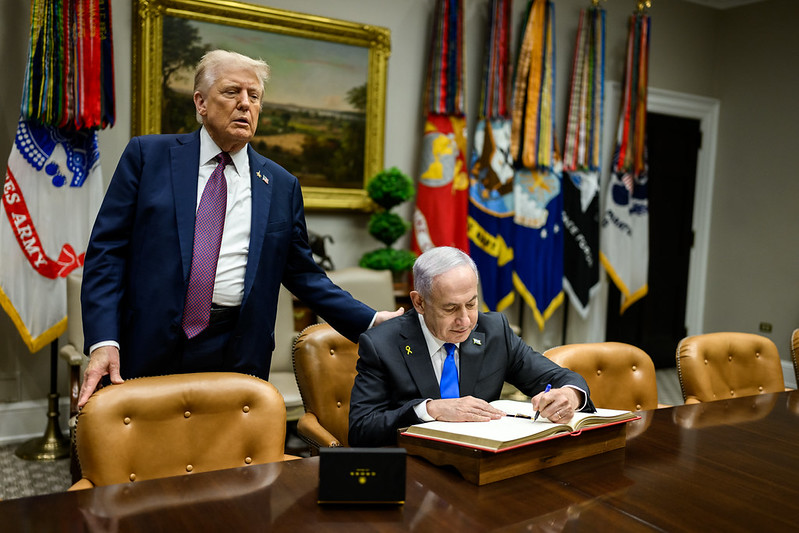
Other senior Israeli officials, including Mossad chief David Barnea, appeared on the screens behind Netanyahu during the hour-long briefing, where the Israeli leader made the “hard sell” for the US and Israel to launch another war against Iran.
The report said Netanyahu made a series of predictions about the potential war that proved to be wrong, including the idea that Iran was ripe for regime change, that its ballistic missile program could be destroyed within weeks, that it would be too weak to close the Strait of Hormuz, and that Iran’s missile strikes on US interests in regional countries would be minimal.
Israeli officials also said that the Mossad assessed that an uprising against the government could start, with the help of Mossad operations on the ground, and that airstrikes could help topple the government. Netanyahu also presented several possibilities of people who could take power in Tehran, including Reza Pahlavi, the exiled son of Iran’s last shah, who had been pushing hard for the US and Israel to launch the war.
The briefing was the opposite of what US intelligence agencies concluded around the same time: that a major US-Israeli war would not result in regime change and would likely harden the Islamic government in Tehran, which is what has happened since the start of the conflict on February 28.
The Times report said that even Trump’s senior officials, including CIA Director John Ratcliffe and Secretary of State Marco Rubio, told the president that they were skeptical of Israel’s claims. Sources told the paper that US officials assessed that the US and Israel could kill Iranian Supreme Leader Ayatollah Ali Khamenei and cripple Iran’s ability to project power, but did not think there would be an uprising or regime change.
The report said that Trump asked Gen. Dan Caine, the chairman of the Joint Chiefs of Staff, what he thought about Israel’s claims. “Sir, this is, in my experience, standard operating procedure for the Israelis. They oversell, and their plans are not always well-developed. They know they need us, and that’s why they’re hard-selling,” the general reportedly said.
Despite the advice, the report said that Trump was very hawkish on the issue and closely aligned with Netanyahu for many months. Sources told the Times that Vice President JD Vance was the administration’s most vocal opponent of the war, but he told the president he would support any decision he made. Publicly, Vance has not criticized the conflict and has backed Trump’s threats to escalate.