Iranian Foreign Minister Abbas Araghchi said on Thursday that the talks between US and Iranian officials in Geneva were one of the most “serious” rounds of negotiations yet, though the threat of a US attack on Iran remains, as there were no signs of a major breakthrough.
Araghchi told Iranian TV that the talks “made very good progress and entered into the elements of an agreement very seriously, both in the nuclear field and in the sanctions field.”
The Iranian diplomat said that another round will likely be held next week and that US and Iranian technical experts will meet in Vienna on Monday to discuss the details of a potential deal. Omani Foreign Minister Badr Albusaidi, who mediated the negotiations, also spoke positively of the talks, saying “significant progress” was made.
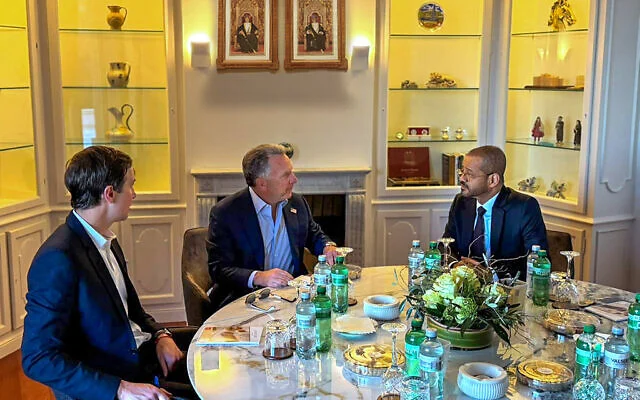
However, according to a report from The Wall Street Journal, the US came to the talks demanding that Iran completely dismantle three of its nuclear sites, hand over its enriched uranium, and commit to never restarting its uranium enrichment program without significant sanctions relief, conditions that are unacceptable r for Tehran.
The US and Iran held a session in the morning, then took a break, during which US envoys Steve Witkoff and Jared Kushner met with Ukrainian officials. According to Axios, Witkoff and Kushner were “disappointed” by the Iranian position in the morning, but after reconvening for a second session, an unnamed US official told the outlet that the talks were “positive” without providing additional details.
According to a report from Amwaj.media, the proposal that Iran submitted to the US included a pledge to never develop nuclear weapons, something President Trump claimed that Iran has refused to do, despite the Iranian Supreme Leader Ayatollah Ali Khamenei’s long-standing fatwa against making a nuclear bomb.
“The guiding principles are meant to secure nuclear fuel production [in Iran] while ensuring no nuclear weapons through measures such as full verification and no accumulation [of enriched uranium],” an Iranian source told Amwaj.media. “This means enrichment would continue only as much as needed.”
Amid the negotiations between the US and Iran, President Trump and his top officials have been claiming that Iran may be taking steps toward a nuclear weapon, despite also insisting that the US “obliterated” Iran’s nuclear facilities in the June 2025 war. Experts and diplomats have rejected the US claims, saying all signs indicate Iran’s nuclear enrichment program has been frozen since the US airstrikes.
Iran has reportedly offered to formally suspend its enrichment program for three to five years, an arrangement that would ensure there would be no Iranian uranium enrichment for the remainder of the Trump administration.
The US has continued its major military buildup in the Middle East and has made movements in the region that suggest it’s still preparing for war. The 12-day US-Israeli war against Iran was launched by Israel when the US and Iran were still holding negotiations. Israel began the war with a series of airstrikes on June 13, two days before the next round of US-Iran talks was supposed to be held.