Senior White House advisor Jared Kushner on Thursday pitched an ambitious plan to transform war-ravaged Gaza into a Mediterranean resort hub, telling global business and political elites at the World Economic Forum annual meeting in Davos that reconstruction could be completed within three years if Hamas fully disarms under the next phase of President Donald Trump’s peace plan.
Speaking at a signing ceremony for Trump’s newly announced “Board of Peace,” Kushner said Gaza’s rebuilding would depend entirely on demilitarization. “Without that, we can’t rebuild,” he said, adding that Hamas’s continued armament would be “what holds back Gaza and the people of Gaza from achieving their aspiration.” The Board of Peace, chaired by Trump, is intended to oversee Gaza’s reconstruction and broader postwar governance.
Kushner concluded his remarks with an appeal for critics – both international and Israeli – to withhold judgment for a month, including those objecting to the participation of Turkey and Qatar, countries Israel has accused of backing Hamas. “Just calm down for 30 days,” he said, arguing that the initiative’s ultimate goal was peace and dignity for both Israelis and Palestinians through cooperation among Arab, Muslim, and Western states.
Trump echoed the optimism, describing Gaza in real-estate terms. “I’m a real estate person at heart,” he said, pointing to Gaza’s coastline as a “beautiful piece of property” that could become something “great to watch” if the plan succeeds. Kushner labeled the proposal’s ambition as aiming for “catastrophic success,” a phrase he used to describe a sweeping redevelopment rather than incremental relief.
Slides shown during the presentation depicted terraced apartment towers, promenades, a seaport, and an airport. Reconstruction would begin in Rafah and move northward to Gaza City, with Kushner insisting there was “no plan B.” He argued that similar cities for millions of residents had been built elsewhere in the region within a few years and that the same could be done in Gaza under the right conditions.
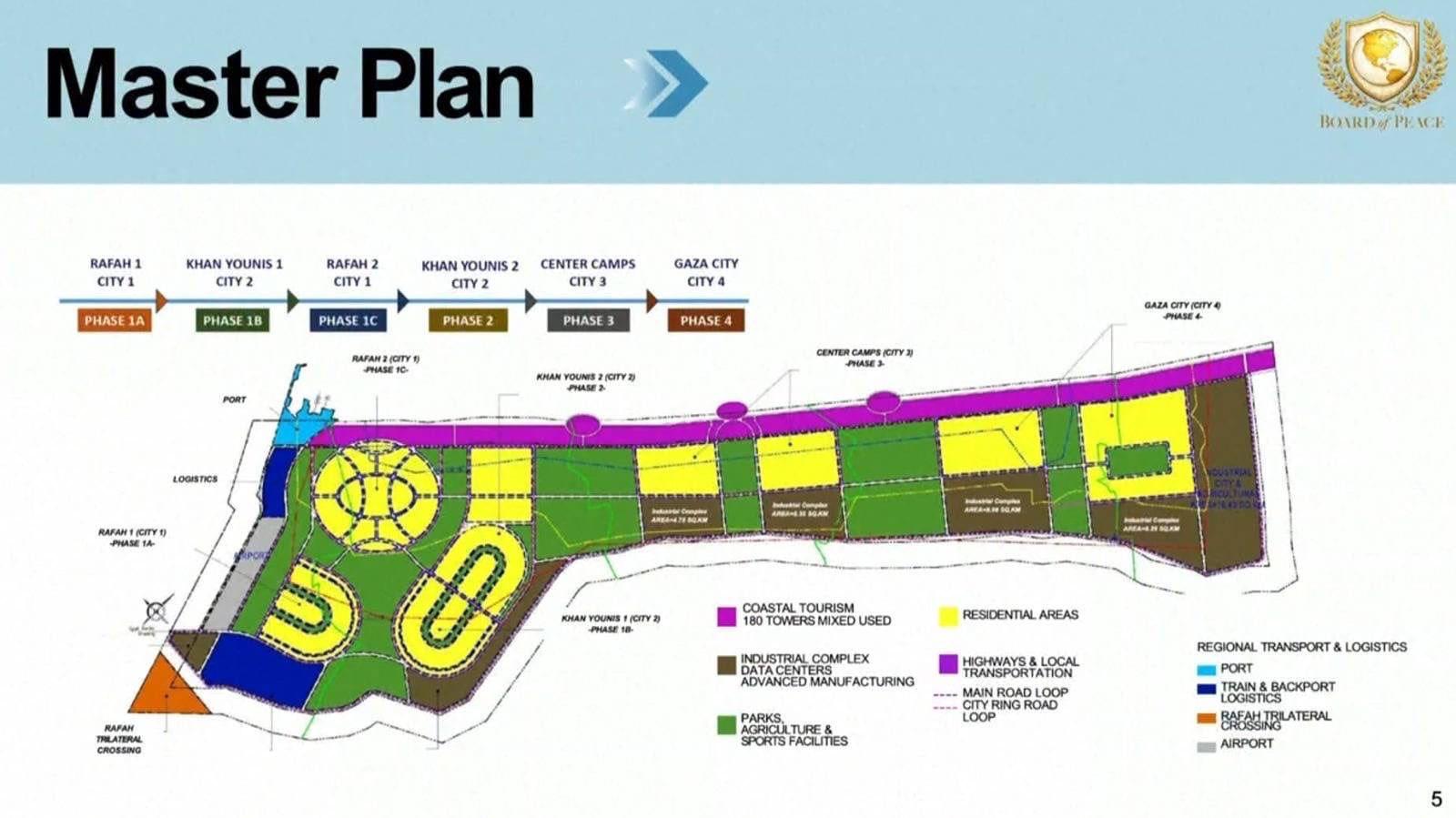
Central to the plan is an economic overhaul. Kushner said roughly 85 percent of Gaza’s economy has long depended on aid, a model he called unsustainable and demeaning. The proposal seeks to introduce “free-market” principles, with a target of $25 billion in investment to rebuild infrastructure and public services destroyed since the October 7, 2023, Hamas attack that triggered the current war. Kushner claimed that within a decade Gaza’s GDP could reach $10 billion, with average household incomes of $13,000 a year and “100 percent full employment.”
Security provisions were outlined in a slide titled “demilitarization principles.” Heavy weapons would be immediately decommissioned, while personal arms would be phased out as a new Palestinian police force gains capacity. Militants who surrender weapons would be offered amnesty, reintegration, or safe passage, with some potentially vetted for roles in a new National Committee for the Administration of Gaza (NCAG), a technocratic body overseen by the Board of Peace. Israeli forces would withdraw to a perimeter only after Gaza-wide demilitarization, according to the plan.
The proposal fits a pattern in Kushner’s approach to the conflict. His presentation leaned heavily on investment, governance reforms, and security guarantees, while setting strict preconditions that place the burden of progress on disarmament. Critics note that this echoes his earlier efforts during Trump’s first term.
Kushner was the architect of the 2019 “Deal of the Century,” a plan that Palestinians widely rejected as an economic inducement divorced from political realities. The initiative promised tens of billions in investment while sidelining issues such as occupation and refugee rights, and it was boycotted by Palestinian leaders. That history, along with Kushner’s close relationship with Israeli Prime Minister Benjamin Netanyahu and his role in moving the U.S. embassy to Jerusalem, fueled perceptions of a pro-Israel tilt.
Also drawing ire are Kushner’s past comments treating Gaza as a real-estate opportunity, including remarks suggesting the enclave’s waterfront could be “very valuable” if residents were relocated during a cleanup and rebuilding phase. Those statements have resurfaced as Kushner again frames Gaza’s future in terms of redevelopment potential.
Whether the “glitzy Gaza” vision gains traction now will depend less on architectural renderings than on political realities on the ground. For the moment, Kushner’s Davos pitch underscores the administration’s belief that security first, markets second, and peace last is the sequence through which Gaza’s future will be decided.
Alan Mosley is a historian, jazz musician, policy researcher for the Tenth Amendment Center, and host of It’s Too Late, “The #1 Late Night Show in America (NOT hosted by a Communist)!” New episodes debut every Wednesday night at 9ET across all major platforms; just search “AlanMosleyTV” or “It’s Too Late with Alan Mosley.”